SEO or GEO? Which Strategy Should You Prioritize in 2026?
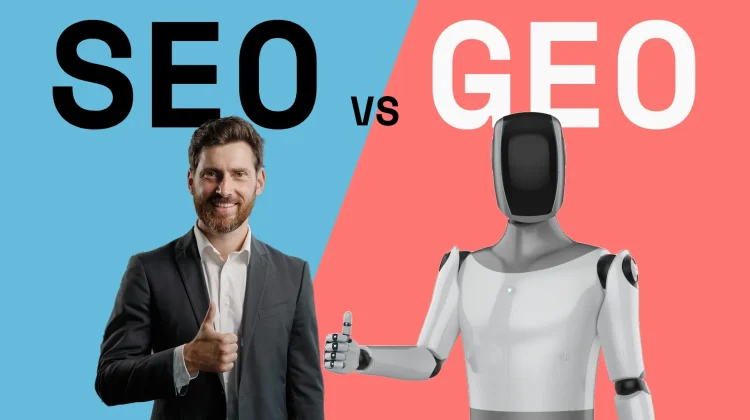
In 2026, the debate is no longer about which strategy is “better,” but how to integrate them. While SEO (Search Engine Optimization) remains the bedrock of web traffic, GEO (Generative Engine Optimization) has become the essential gateway to being cited and recommended by AI.
At Media Serve, we treat these not as competing tactics, but as two sides of the same Visibility Coin.
1. The Core Difference: Traffic vs. Trust
The shift in 2026 is a move from “ranking for clicks” to “optimizing for reuse.”
-
SEO (Search Engine Optimization): Focuses on being found in a ranked list of links. It drives users directly to your site to convert.
-
Goal: Clicks, sessions, and destination-based traffic.
-
-
GEO (Generative Engine Optimization): Focuses on being cited within an AI’s answer (like ChatGPT, Perplexity, or Google AI Overviews). It shapes the narrative before the user even visits your site.
-
Goal: Brand authority, AI mentions, and “Answer-Engine” dominance.
-
2. 2026 Strategy Breakdown: SEO vs. GEO
| Feature | Traditional SEO (2026) | Generative Engine Optimization (GEO) |
| Primary Target | Search Bots (Google/Bing) | LLMs (GPT-5, Gemini, Perplexity) |
| Content Goal | Top-3 Rank for Keywords | Inclusion in AI Summaries & Citations |
| Key Metric | Click-Through Rate (CTR) | AI Visibility Score & Mention Frequency |
| Winning Content | Long-form, pillar pages, backlinks | Fact-dense, modular, “Answer-first” blocks |
| Technical Focus | Core Web Vitals & Indexability | Semantic Schema & Entity Clarity |
3. Why You Must Prioritize Both (The Hybrid Model)
In 2026, skipping one collapses the other. Here is how they feed each other in the Media Serve framework:
Phase 1: SEO as the Foundation
Without technical SEO (fast speeds, crawlable architecture, and HTTPS), AI scrapers cannot find your content. SEO creates the structural conditions for discovery. If the bots can’t read your site, the AI can’t cite your brand.
Phase 2: GEO as the Authority Layer
Once discovered, your content must be “recommendation-safe.” GEO ensures your content is:
-
Fact-Dense: AI prefers verifiable data, statistics, and original research over marketing fluff.
-
Modular: Content is structured in clear “Answer Blocks” that AI can easily extract and summarize.
-
Trustworthy: Using E-E-A-T (Experience, Expertise, Authoritativeness, Trustworthiness) to prove you aren’t an AI-generated content farm.
4. The 2026 “Winner’s Circle” Checklist
To dominate both traditional and AI search this year, your strategy must include:
-
Direct Answer Injection: Place a clear, 2-3 sentence answer within the first 50–70 words of your headings.
-
Semantic Topic Clusters: Don’t just target “web design.” Build a cluster around “AI-integrated UX,” “Zero-latency hosting,” and “Conversion-centric UI” to signal deep topical authority.
-
Third-Party Validation: Earn mentions on high-authority platforms (Reddit, industry journals, news sites). AI models look for “patterns of trust” across the entire web, not just your site.
-
Structured Data (Schema 3.0): Implement advanced Schema.org markup to tell AI exactly what your entities are (e.g., “This is a Product,” “This is a Verified Founder”).
Conclusion: SEO Gets You Found, GEO Gets You Chosen
In 2026, the brands that win aren’t just the ones at the top of Google; they are the ones that the AI recommends to the user. At Media Serve, we specialize in Integrated Search Visibility, ensuring your brand owns the “Blue Links” and the “AI Answers” simultaneously.
No reviews yet. Be the first to review!